

When financial news says “the dollar rose”, it usually means the US Dollar Index, often called the DXY or USDX, went up. It is the most widely followed measure of the US dollar’s overall strength. This guide explains what it is, how it works and how forex traders use it.
In brief:
- The DXY measures the US dollar against a basket of six major currencies.
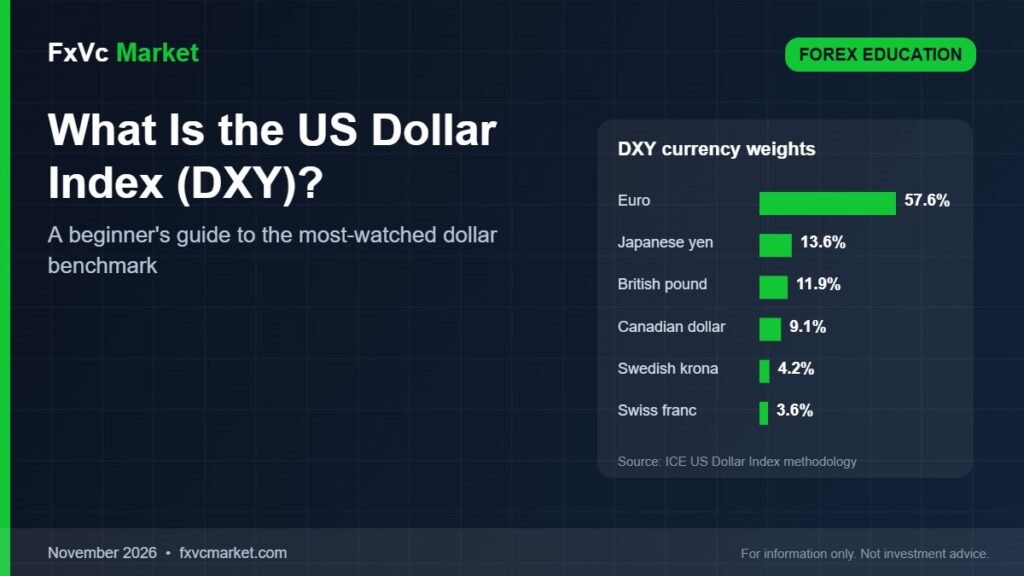
- The euro makes up more than half of the index, at about 57.6%.
- The index started at 100 in March 1973; a reading above 100 means the dollar is stronger than at that starting point.
- A rising DXY usually means a stronger dollar, which tends to weigh on EUR/USD, GBP/USD and gold.
What the DXY measures
The US Dollar Index tracks the value of the dollar against a weighted basket of six currencies. Because it is a single number, it gives a quick snapshot of whether the dollar is broadly strengthening or weakening, rather than looking at one currency pair at a time.
| Currency | Weight in the DXY |
| Euro (EUR) | 57.6% |
| Japanese yen (JPY) | 13.6% |
| British pound (GBP) | 11.9% |
| Canadian dollar (CAD) | 9.1% |
| Swedish krona (SEK) | 4.2% |
| Swiss franc (CHF) | 3.6% |
Because the euro dominates the basket, the DXY tends to move almost as a mirror image of EUR/USD. Important currencies such as the Chinese yuan and Mexican peso are not included, so the index is not a perfect measure of the dollar against all US trading partners.
How to read the number
The index was set at 100 when it began in March 1973. A reading of 103, for example, means the dollar is about 3% stronger against the basket than it was then. What matters most for traders is the direction and speed of change: a rise from 99 to 103 in a few weeks is a significant dollar rally. In November 2026 the index rose to around 103, its highest since April 2025. See Dollar hits 19-month high.
What moves the dollar index
- US interest rates: higher Fed rates and Treasury yields usually support the dollar. Read how interest rates move forex.
- Economic data: strong jobs, inflation and growth figures can lift the dollar. See how to trade the CPI report.
- Other central banks: if the ECB or Bank of Japan tighten policy, their currencies can gain against the dollar, pushing the DXY down.
- Risk sentiment: in times of global stress, investors often buy dollars as a safe haven.
How forex traders use the DXY
- To confirm a trend: if the DXY is rising, a short trade on EUR/USD or GBP/USD lines up with the broader dollar move.
- To spot divergences: if the DXY is rising but a pair such as AUD/USD is holding steady, that currency may have its own strength.
- To understand gold: gold is priced in dollars, so a strong DXY often weighs on gold. See gold in 2026.
- To manage risk: many trades in different dollar pairs may really be one big bet on the dollar. Checking the DXY helps avoid doubling up. Read our risk management checklist.
Can you trade the DXY?
Yes. Dollar index futures trade on the ICE exchange, and some brokers offer CFDs on the dollar index. However, many beginners simply use the DXY as a reference chart while trading major pairs such as EUR/USD. Leveraged products carry a high risk of loss, so practise on a demo account first.
Summary
The US Dollar Index is a simple way to see the dollar’s overall strength against six major currencies, led by the euro. It is driven mainly by interest rates, economic data and global risk mood. Used alongside individual currency pairs, it can help you understand the bigger picture and avoid taking too much dollar risk at once.
Risk warning: Trading forex and CFDs on margin carries a high level of risk and may not be suitable for all investors. You could lose money rapidly due to leverage. Past performance is not an indication of future results. This article is for education only and is not investment advice.