
Every month, the US Consumer Price Index (CPI) is one of the biggest scheduled events in the forex market. In a few seconds after its release, EUR/USD, USD/JPY and gold can move more than they do in an entire quiet day. This guide explains what CPI is, why it moves currencies, and how to approach CPI day with a clear plan, especially if you are new to trading.
In brief:
- CPI measures the change in prices paid by US consumers, and is released by the Bureau of Labor Statistics, usually around the middle of each month at 8:30 am Eastern time.
- Markets react to the surprise, the difference between the actual figure and the forecast, not the number itself.
- A hotter-than-expected CPI tends to lift US yields and the dollar and weigh on gold and stocks; a cooler reading tends to do the opposite.
- The safest approach for most beginners is to reduce risk before the release and wait for markets to settle.
What is CPI?
The Consumer Price Index tracks the average change in prices of a basket of goods and services, from food and fuel to rent and healthcare. Two versions matter most:
- Headline CPI: all items, including volatile food and energy prices.
- Core CPI: excludes food and energy, so it gives a clearer picture of underlying inflation. Many traders and central bankers watch core most closely.
Each release shows the change from the previous month (month on month) and from a year earlier (year on year).
Why CPI moves the forex market
Inflation data shapes expectations for interest rates. If inflation is running hot, the Federal Reserve is more likely to raise rates or keep them high, which makes the US dollar more attractive. In 2026, with the Fed back in a hiking cycle, CPI has become even more important. Read The Fed is raising rates again in 2026 and how interest rates move forex markets.
It is all about the surprise
Before each release, economists publish a consensus forecast. Markets “price in” that expectation. When the actual figure comes out:
| Result vs forecast | Typical reaction (tendency only) |
| Hotter than expected | US yields up, US dollar up, gold down, stocks down |
| In line with forecast | Smaller moves; focus shifts to details and other data |
| Cooler than expected | US yields down, US dollar down, gold up, stocks up |
These are tendencies, not rules. Sometimes the first move reverses within minutes, especially if core and headline CPI point in different directions, or if other news is driving markets.
Which pairs move most on CPI?
- EUR/USD: the most liquid pair, usually with the cleanest reaction.
- USD/JPY: very sensitive to US yields, and can move sharply.
- GBP/USD: often volatile, and influenced by Bank of England expectations too.
- Gold (XAU/USD): reacts strongly to changes in yields and the dollar. See gold in 2026.
- US index CFDs: the S&P 500 and Nasdaq can swing on rate expectations.
Step-by-step: a CPI day plan
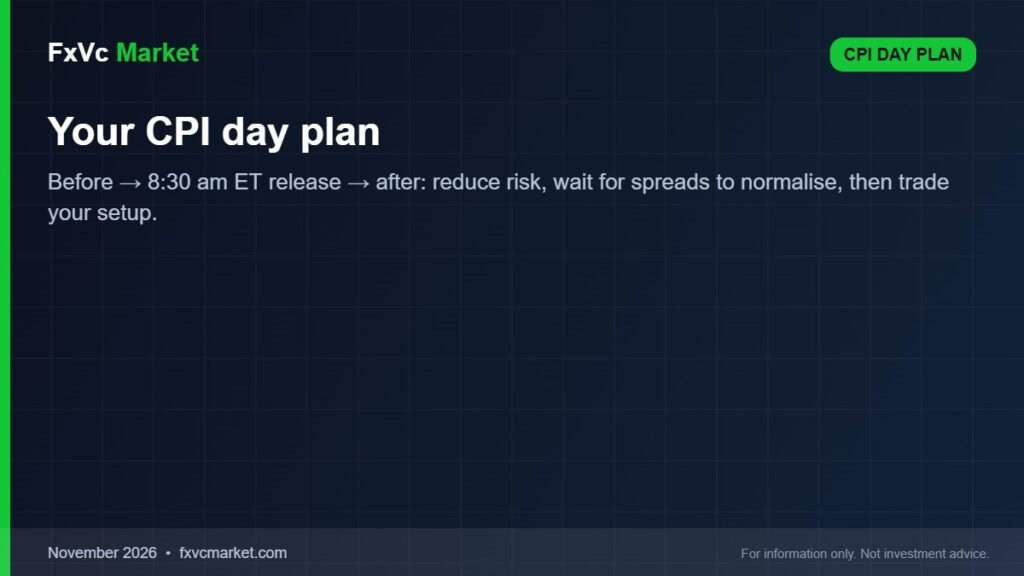
- Check the calendar: confirm the release date and time, and note the consensus forecasts for headline and core CPI.
- Review open positions: decide whether to reduce or close trades before the release. Large moves can hit stop-losses or cause slippage.
- Avoid trading in the first minutes: spreads can widen sharply right after 8:30 am ET, and prices can jump without trading in between.
- Read the details: compare both headline and core, month on month, against forecasts. Look for revisions to the previous month.
- Wait for the market to settle: many experienced traders wait 15–30 minutes for the first spike to fade and a clearer direction to form.
- Trade your setup, not the headline: only enter if your normal strategy gives a signal, with a stop-loss and a small position size.
- Record it in your journal: note what happened and how you reacted, to improve next time.
Common mistakes to avoid
- Using high leverage to “catch” the first move.
- Trading without a stop-loss, or placing it too close inside normal volatility.
- Ignoring core CPI and reacting only to the headline number.
- Revenge trading after a whipsaw. Read forex trading psychology.
- Forgetting that spreads and slippage can make losses larger than planned. See can you lose more than you invest?.
Practise first
The best way to learn how CPI affects markets is to watch a few releases on a demo account, noting how each pair reacts. Combine that with strict risk management before trading real money. For this month’s numbers, see our October CPI preview.
Risk warning: Trading forex and CFDs around economic data releases carries a very high level of risk. Prices can move sharply, spreads can widen and orders can be filled at worse prices than expected. You could lose money rapidly due to leverage. This article is for education only and is not investment advice.
Sources
- US Bureau of Labor Statistics: Consumer Price Index
- BLS: CPI release schedule
- Federal Reserve: Monetary policy