
Searches for “AI forex trading software” and “artificial intelligence forex trading software” have grown fast as more products promise to trade the markets for you. Some are genuine tools; others are expensive black boxes or outright scams. This guide explains how AI trading software works, the risks most sellers do not mention, and gives you a practical checklist to judge any product before you spend a cent.
In brief:
- “AI forex trading software” usually means an automated trading robot, a signals service or an analysis assistant that uses machine learning.
- No AI can predict markets reliably; past results, especially simulated ones, often fail in live trading.
- The biggest risks are hidden risk-taking (no stop-loss, grid or martingale), over-fitted results and anonymous sellers.
- Use our 10-point checklist before paying for any product, and always test on a demo account first.
What is AI forex trading software?
The term covers several different kinds of product:
| Type | What it does | Who controls trades? |
| AI trading robot (Expert Advisor / bot) | Opens and closes trades automatically on your account | The software |
| AI signals service | Sends trade ideas you can follow manually | You |
| AI copy trading | Your account copies a “master” account run by the provider | The provider |
| AI analysis assistant | Summarises news, scans charts, helps with research | You |
This guide focuses mainly on software that trades for you, because it carries the most risk. For research assistants, see AI tools for forex trading: what they can and can’t do.
How AI trading software works
Most products follow a similar pattern. The software reads recent price data, and sometimes news or other inputs, runs it through a model trained on past market behaviour, and produces a decision: buy, sell, hold or close. A robot then sends orders to your broker account, usually on MetaTrader 4 or 5. Some products run the model on your computer; others send data to the provider’s cloud server, which means they stop working if that server goes down.
The real risks
- Over-fitting: a model tuned to look perfect on historical data often performs very differently in live markets.
- Hidden risk-taking: systems without stop-losses, or that add to losing trades (grid or martingale methods), can show smooth profits for months before a single bad move wipes out the account.
- Black boxes: if you cannot understand why it trades, you cannot judge when it is likely to fail.
- Dependence on the seller: cloud-based or licence-checked software can stop working if the company disappears.
- Scams: regulators regularly warn about “AI trading” products that promise fixed returns, use fake results or take payments and vanish. See how to spot forex scams.
- Leverage: automated systems can open large positions quickly. Read can you lose more than you invest?.
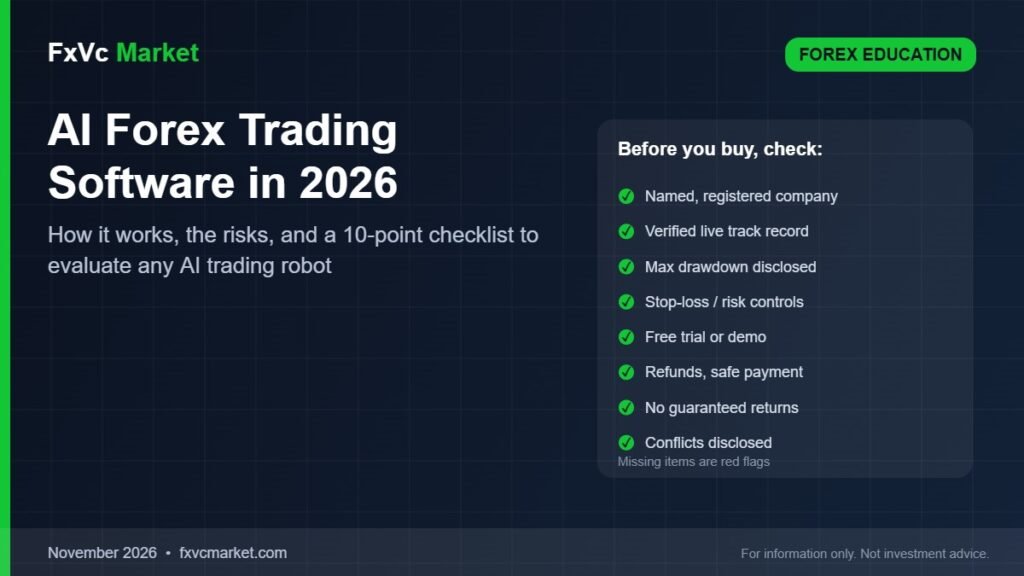
10-point checklist to evaluate any AI trading software
- Company identity: is there a named, registered company with a real address?
- Regulation: does the product or service need a licence where you live, and does it have one?
- Verified track record: are live results independently verified (for example on Myfxbook or FX Blue) over at least 6–12 months, not just backtests?
- Drawdown: does it disclose the largest historical loss from peak to trough?
- Risk controls: does it use a stop-loss on every trade? Does it avoid grid or martingale methods?
- Transparency: can you understand the strategy well enough to know when it might fail?
- Free trial or demo: can you test it before paying?
- Payment and refunds: can you pay by a method with buyer protection, and is there a refund policy?
- No guaranteed returns: any promise of fixed or guaranteed profit is a red flag.
- Conflicts of interest: does the seller earn broker commissions or run the copy-trading account themselves?
Worked example: KairoFX
To show how the checklist works in practice, we applied it to KairoFX, an AI-powered Expert Advisor for MetaTrader 5 that trades gold (XAUUSD), using the information on its website in November 2026.
| Checklist item | KairoFX |
| Company identity | Not found: no legal name, country or address published |
| Regulation | No licence claimed |
| Verified track record | Not published |
| Drawdown disclosed | Not published |
| Risk controls | No fixed stop-loss; can hold several positions at once |
| Transparency | Proprietary “AI engine”; strategy not explained in detail |
| Free trial or demo | Yes, free demo trial |
| Payment and refunds | $1,999 in USDT via Telegram; no refunds |
| No guaranteed returns | Yes: “We make no promise of profit” |
| Conflicts disclosed | Yes: discloses broker referral commission |
KairoFX scores well on honesty about risk and offers a free demo, but it is missing several of the most important protections. Read our full KairoFX review for details and our verdict.
How to test AI software safely
- Start with a demo account and run it for several months, across different market conditions.
- Record every trade and the largest drawdown in a journal.
- If you go live, start with a small amount you can afford to lose and set a maximum loss at which you switch it off.
- Keep using sound risk management; automation does not remove risk.
Is AI forex trading software worth it?
It can be useful for disciplined traders who understand the strategy and test it thoroughly, but it is not a shortcut to profit. Most of the value comes from transparency, verified results and strong risk controls, not from the word “AI”. If a product cannot answer the checklist above, it is safer to walk away. For automation more broadly, see automated forex trading: EAs and trading bots.
Risk warning: AI trading software and leveraged forex and gold trading carry a high level of risk. You could lose some or all of your money. Past or simulated performance is not an indication of future results. This article is for education only and is not investment advice or a recommendation of any product.
Sources
- KairoFX: official website (worked example)
- FCA: Online trading scams
- CFTC: AI won’t turn trading bots into money machines