

Financial news is full of phrases like “the Fed raised rates by 25 basis points” or “yields jumped 18 basis points”. If you have ever wondered exactly what a basis point is, and why traders care so much about the difference between 25 and 50 of them, this guide explains it in plain English.
In brief:
- One basis point (bp) is 0.01%, or one-hundredth of one percent.
- 100 basis points = 1%. A 25 bp hike = 0.25%; a 50 bp hike = 0.50%.
- Basis points avoid confusion when talking about changes in percentages.
- In December 2026, markets are debating whether the Fed will hike by 25 or 50 bp.
What is a basis point?
A basis point is a unit used to describe small changes in interest rates, yields and other percentages. One basis point equals 0.01%. So if a bond yield rises from 4.90% to 5.00%, it has risen by 10 basis points.
| Basis points | Percentage |
| 1 bp | 0.01% |
| 10 bp | 0.10% |
| 25 bp | 0.25% |
| 50 bp | 0.50% |
| 100 bp | 1.00% |
Why not just say “percent”?
Because percentages of percentages get confusing. If a rate goes from 4% to 5%, is that a “1% rise” or a “25% rise”? Both are technically true. Saying it rose by “100 basis points” removes any doubt.
25 vs 50 bp: what is the difference in practice?
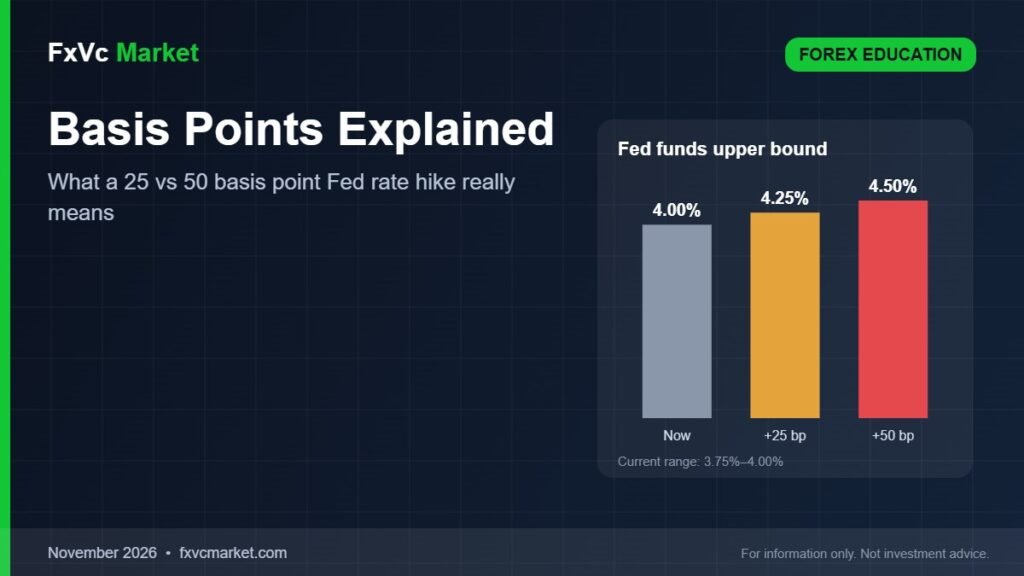
The Fed’s policy rate is currently a range of 3.75%–4.00%. A 25 bp hike would move it to 4.00%–4.25%; a 50 bp hike would take it to 4.25%–4.50%. Fed officials have signalled more hikes are likely, and some have suggested 50 bp may be needed. See what the Fed minutes showed.
- For borrowers: on a $300,000 variable-rate loan, a 25 bp rise adds roughly $750 a year in interest, and a 50 bp rise about $1,500 (simplified example).
- For bond holders: as a rough rule of thumb, a bond’s price falls by about its “duration” multiplied by the rise in yield. For a bond with a duration of 8, a 50 bp rise in yield means a price fall of roughly 4%.
- For savers: higher rates usually mean better returns on cash, although banks do not always pass increases on in full.
Why basis points matter to forex traders
Currencies are heavily influenced by the difference in interest rates between two countries. If the Fed hikes by 50 bp while the Bank of Japan stays on hold, the rate gap widens, which tends to support the dollar against the yen. That is one reason USD/JPY has climbed towards 160. Read why the yen is weakening and how interest rates move forex.
What matters most is the surprise. If markets expect 25 bp and the Fed delivers 50 bp, the reaction is usually much bigger than if the larger move was already priced in.
Don’t confuse basis points with pips
A pip is the standard unit of price movement in a currency pair (usually 0.0001 in EUR/USD), while a basis point measures changes in interest rates and percentages. They are different things, although both describe small moves. New to pips? Start with what is forex and how does it work.
How to use this knowledge
- Check what move markets expect before a central bank meeting (for example, using tools such as CME FedWatch).
- Compare the decision with expectations: the surprise drives the reaction.
- Watch bond yields in basis points; big daily moves (10–20 bp) often signal shifts in rate expectations that also move currencies.
- Reduce risk around major decisions. See our guide to trading data releases.
Risk warning: Trading forex, bonds and CFDs on margin carries a high level of risk and may not be suitable for all investors. You could lose money rapidly due to leverage. Examples in this article are simplified for education. This article is not investment advice.